 InvestIntel
Light
Dark
InvestIntel
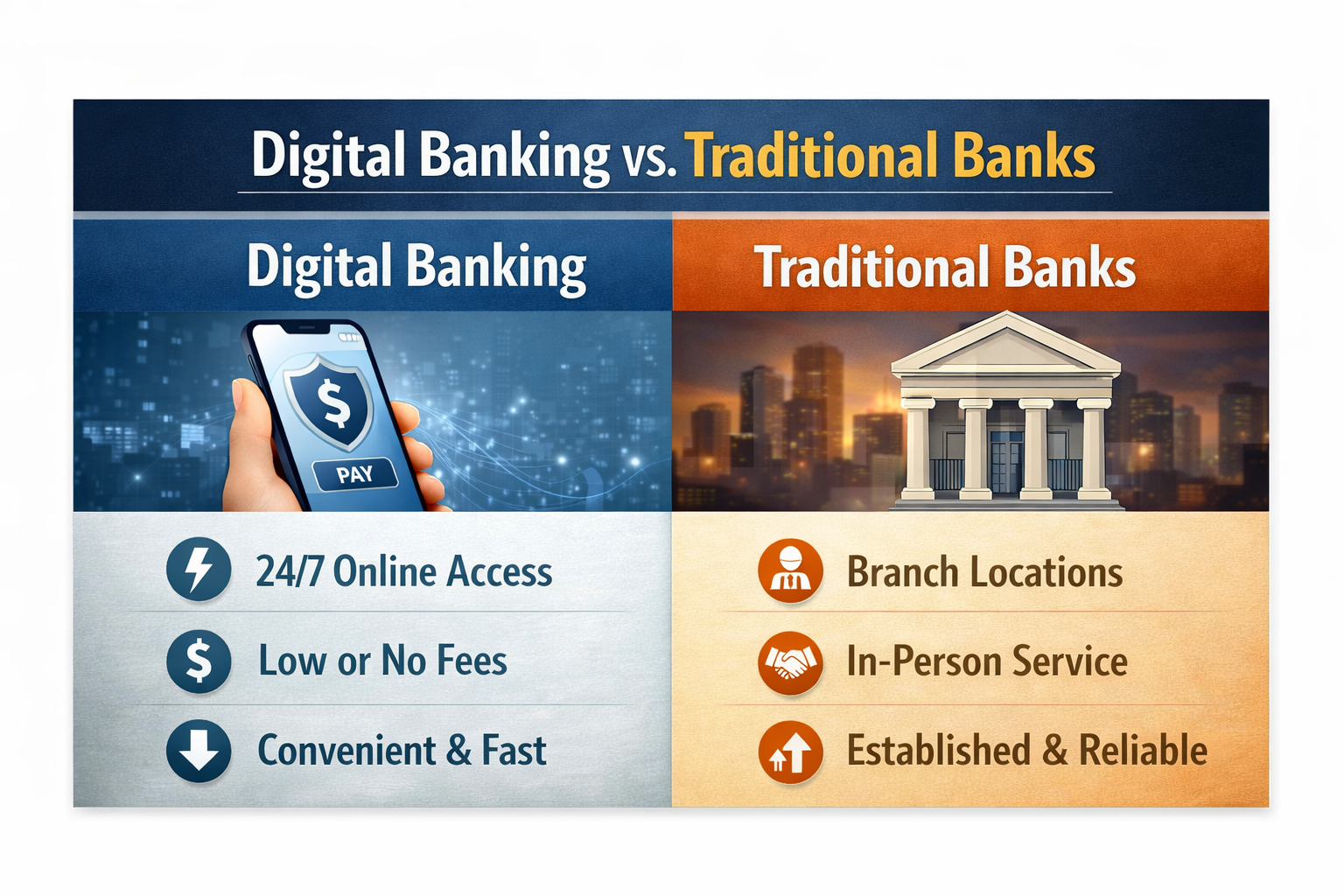
The way we manage money has changed dramatically over the past decade. Tasks that once required visiting a physical bank branch can now be completed in seconds using a smartphone.
With the rapid growth of financial technology, many consumers are asking an important question: Is digital banking better than traditional banking?
Both options offer unique advantages and potential drawbacks. The right choice depends on your financial habits, comfort with technology, and long-term goals. Let’s break down the differences to help you decide.
Digital banking refers to financial institutions that operate primarily — or entirely — online. These banks typically do not have physical branches. Instead, customers manage their accounts through:
Mobile apps
Online platforms
Phone or chat support
Digital banks often focus on simplicity, speed, and lower operating costs. Because they don’t maintain branch networks, they can sometimes pass savings on to customers through lower fees and higher interest rates.
Traditional banks are brick-and-mortar institutions with physical branch locations. Customers can visit in person for services such as:
Opening accounts
Applying for loans
Depositing cash
Speaking directly with a banker
Traditional banks often offer a wider range of financial products, including mortgages, investment services, business accounts, and wealth management solutions.
For many customers, the ability to speak face-to-face with a financial professional adds an extra layer of trust and comfort.
Digital banking is built around convenience. Customers can:
Access accounts 24/7
Transfer money instantly
Deposit checks using mobile apps
Pay bills online
Traditional banks provide accessibility through branch networks and ATMs, but services may be limited to business hours.
If flexibility and remote access are priorities, digital banking has a clear advantage.
One of the biggest reasons consumers switch to digital banking is cost savings.
Digital banks often offer:
No monthly maintenance fees
Lower overdraft fees
Higher interest rates on savings accounts
Traditional banks may charge higher fees due to the cost of maintaining physical branches and staff. However, some waive fees if minimum balance requirements are met.
Customer service is where the two options differ significantly.
Digital banks provide support through:
Live chat
Phone assistance
Traditional banks offer:
In-person consultations
Dedicated relationship managers
Personalized financial advice
If you prefer face-to-face interaction, traditional banking may be more appealing.
Traditional banks make cash deposits and withdrawals simple through branch tellers and ATMs.
Digital banks may offer ATM access, but cash deposits can sometimes be more complicated or limited to partner locations.
If you regularly handle cash, a traditional bank might be more practical.
Both digital and traditional banks must follow strict financial regulations and security standards. Reputable institutions use:
Data encryption
Two-factor authentication
Fraud monitoring systems
Your deposits are typically insured up to the legally protected limits, regardless of whether you choose a digital or traditional bank.
Pros:
Lower fees
Higher savings interest rates
24/7 access
Fast and convenient transactions
Cons:
No physical branches
Limited cash deposit options
May not offer advanced financial services
Pros:
In-person customer support
Wider range of financial products
Easy cash deposits and withdrawals
Cons:
Higher fees
Lower savings interest rates
Slower processes in some cases
Choose digital banking if:
You are comfortable using mobile apps
You want lower fees
You rarely need to deposit cash
You prefer managing finances independently
Choose traditional banking if:
You value face-to-face customer service
You frequently handle cash
You want access to complex financial services
You prefer a long-established institution
Many consumers today use a combination of both — a digital bank for savings and everyday transactions, and a traditional bank for loans or specialized services.
The debate between digital banking and traditional banks isn’t about which is universally better. It’s about which aligns with your financial lifestyle and goals.
Digital banking offers speed, convenience, and cost efficiency. Traditional banks provide personal interaction and a broader range of services.
Before making your decision, consider how you manage money, what services you need, and how important in-person support is to you. The right choice can simplify your finances and support your long-term financial success.