 InvestIntel
Light
Dark
InvestIntel
Bitcoin has transformed the financial world since its launch in 2009. It has experienced dramatic price increases, sharp declines, regulatory scrutiny, and widespread adoption. But many investors still ask the same question: Is Bitcoin still a good investment?
The answer depends on your risk tolerance, financial goals, and understanding of cryptocurrency markets. Bitcoin remains one of the most talked-about digital assets, but it also carries significant volatility.
In this guide, we examine the current investment case for Bitcoin in a balanced and responsible way.
Bitcoin is a decentralized digital currency that operates on blockchain technology. Unlike traditional currencies, it is not controlled by a central bank or government.
Key characteristics of Bitcoin include:
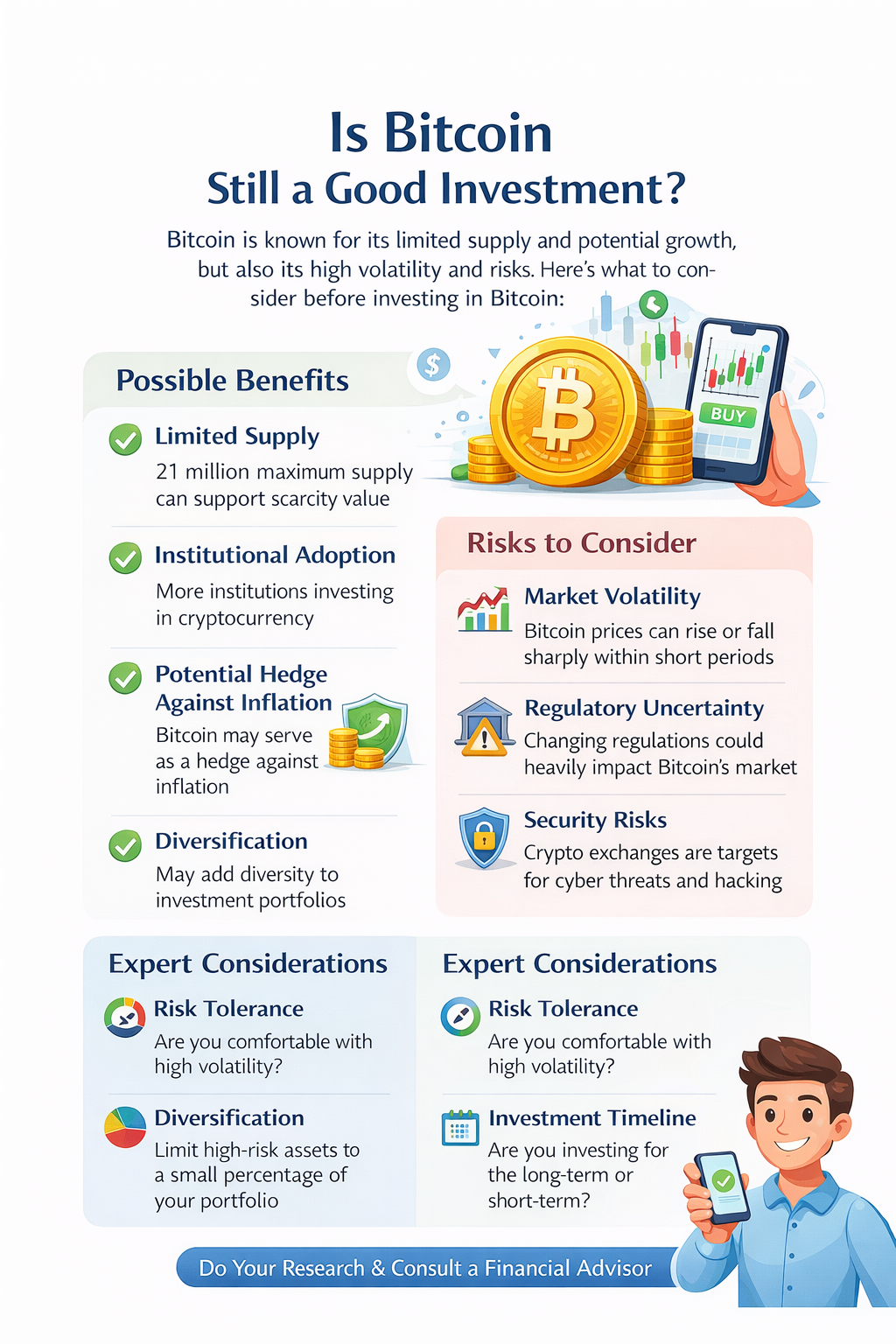
Limited supply (21 million coins maximum)
Peer-to-peer transactions
Blockchain transparency
High price volatility
Its limited supply is one reason some investors view Bitcoin as a potential hedge against inflation.
Bitcoin’s fixed supply makes it different from traditional fiat currencies. Scarcity can support long-term value if demand continues to grow.
Over recent years, institutional investors and financial firms have entered the cryptocurrency space. This has increased market legitimacy and liquidity.
As digital finance expands globally, cryptocurrencies remain part of broader financial innovation trends.
Some investors include Bitcoin in diversified portfolios because it behaves differently from traditional assets like stocks and bonds.
Bitcoin is not a guaranteed investment. It carries real risks.
Bitcoin prices can fluctuate dramatically within short periods. Large gains can be followed by sharp declines.
Governments continue to develop cryptocurrency regulations. Changes in laws can affect market prices and accessibility.
While blockchain itself is secure, exchanges and digital wallets can be targets for cybercrime if not properly protected.
Bitcoin does not generate income like dividends or interest. Its value depends entirely on market demand.
Some investors view Bitcoin as a long-term asset due to its limited supply and growing adoption. Others see it as speculative because of price volatility.
When evaluating Bitcoin as a long-term investment, consider:
Your financial goals
Your risk tolerance
Your investment timeline
Your overall portfolio allocation
Financial experts often recommend investing only money you can afford to lose in high-risk assets.
Bitcoin may be suitable for:
Investors comfortable with high volatility
Individuals seeking diversification
Those interested in digital finance innovation
Bitcoin may not be ideal for:
Risk-averse investors
Individuals nearing retirement
Anyone relying on stable short-term returns
There is no universal answer. Many financial advisors suggest limiting high-risk assets to a small percentage of your overall portfolio.
Diversification remains one of the most important principles of investing.
Is Bitcoin still a good investment? It can be — but only for the right investor.
Bitcoin offers potential upside due to scarcity, adoption, and innovation. However, it also carries significant volatility and regulatory risks.
Before investing, conduct thorough research and consider consulting a qualified financial professional. Cryptocurrency markets can be unpredictable, and responsible investing requires careful planning. Secure Your Wallet
Bitcoin is considered a high-risk investment due to price volatility. Investors should understand the risks before investing.
While unlikely, Bitcoin’s price can decline significantly. Cryptocurrency markets are not guaranteed.
Bitcoin and stocks serve different investment purposes. Bitcoin is more volatile, while stocks may offer dividends and long-term growth.