 InvestIntel
Light
Dark
InvestIntel
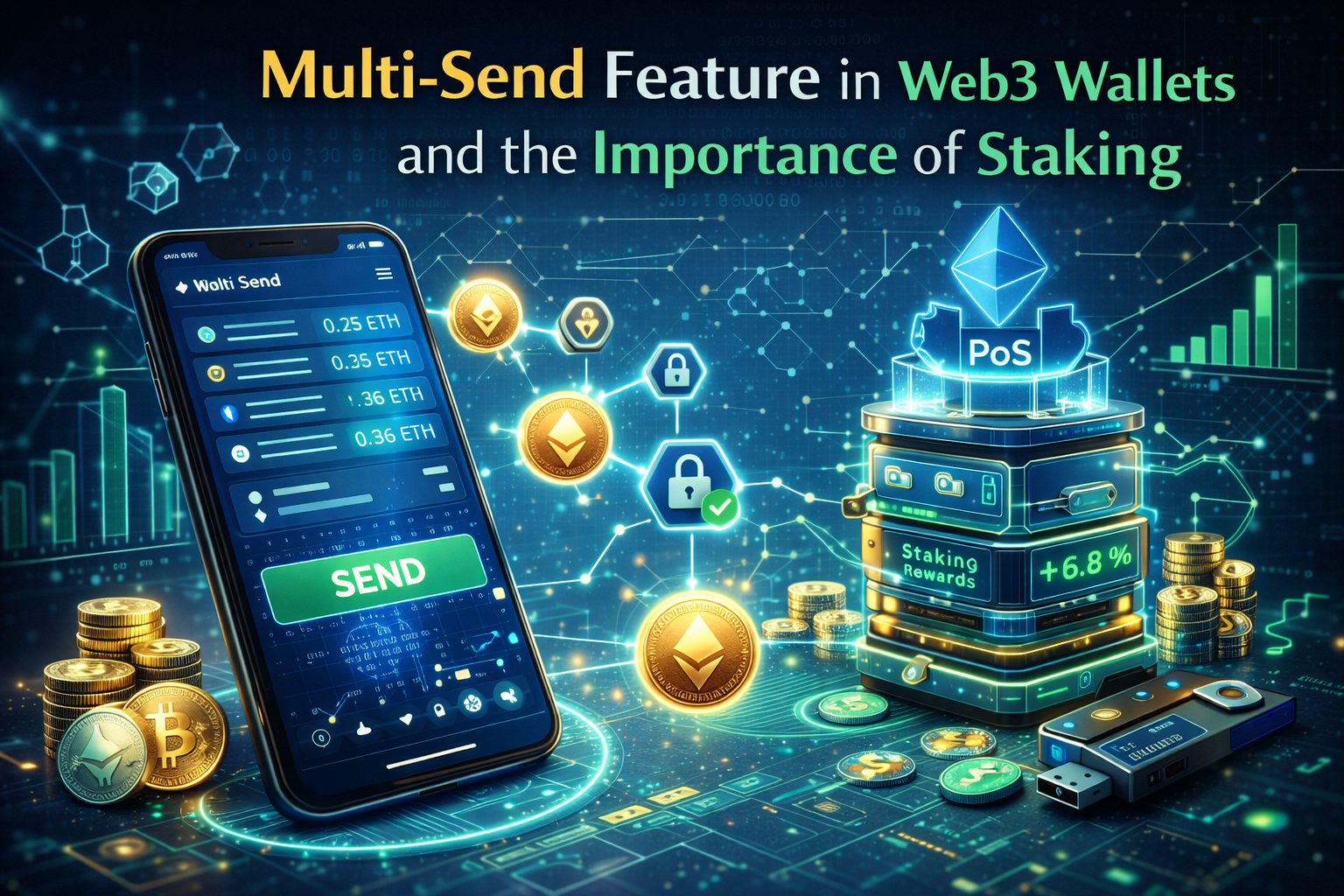
Web3 wallets continue to evolve beyond simple send-and-receive functionality. Modern wallets now include advanced tools that improve efficiency and participation in decentralized networks.
Two important features gaining attention are the multi-send feature in Web3 wallets and staking capabilities. Multi-send enhances transaction efficiency, while staking allows users to support blockchain networks and potentially earn rewards.
Understanding both can help users make better use of decentralized finance tools.
The multi-send feature in Web3 wallets allows users to send cryptocurrency to multiple wallet addresses in a single transaction.
Instead of sending funds one by one, users can:
Upload multiple recipient addresses
Specify individual amounts
Execute a single batch transaction
This feature is commonly used for:
Airdrops
Payroll distribution
Token rewards
Community payouts
Multi-send simplifies large-scale transfers and reduces manual effort.
Sending crypto to dozens or hundreds of addresses individually can be time-consuming. Multi-send automates this process.
In some networks, batching transactions may reduce total fees compared to sending separate transactions.
Uploading recipient lists reduces the risk of repeated manual entry errors.
Projects and decentralized organizations often use multi-send for treasury operations and reward distribution.
While convenient, users should take precautions:
Double-check recipient addresses
Confirm transaction amounts
Review network fees
Test with a small batch first
Once a blockchain transaction is confirmed, it typically cannot be reversed.
Staking involves locking cryptocurrency in a blockchain network to support its operations.
Many modern blockchains use Proof-of-Stake (PoS) or similar consensus mechanisms.
When users stake tokens, they help:
Validate transactions
Secure the network
Maintain decentralization
In return, participants may receive staking rewards. Start Staking
Staking strengthens blockchain security by requiring validators to lock assets as collateral.
Staking rewards encourage users to participate in network governance and validation.
When tokens are staked, they are temporarily removed from circulation, which may influence supply dynamics.
Some investors view staking as a way to earn yield on held assets, though returns vary by network and market conditions.
The multi-send feature in Web3 wallets and staking both support broader blockchain ecosystems.
For example:
Projects may distribute staking rewards using multi-send
DAOs may reward contributors through batch transfers
Validators may manage payouts efficiently
Together, these features enhance operational efficiency and network participation.
Both multi-send and staking carry risks.
Sending funds to incorrect addresses
Misconfigured batch files
High network congestion fees
Lock-up periods
Slashing penalties for validators
Market volatility affecting token value
Users should research carefully before participating.
To maximize safety and efficiency:
Use reputable Web3 wallets
Enable multi-factor authentication
Understand staking lock-up terms
Keep private keys secure
Monitor network updates
Security remains the user’s responsibility in decentralized systems.
The multi-send feature in Web3 wallets improves transaction efficiency by enabling batch transfers to multiple addresses.
At the same time, staking plays a crucial role in maintaining blockchain security and incentivizing participation.
Together, these features reflect the growing sophistication of Web3 infrastructure.
Understanding how they work allows users to participate more effectively and responsibly in decentralized ecosystems.
It allows users to send cryptocurrency to multiple addresses in a single transaction.
Staking can be secure when done through reputable platforms, but it carries risks such as lock-up periods and market volatility.
Yes, but it is important to carefully review recipient addresses and amounts before confirming transactions.